What happens when continuous improvement makes your shadow board obsolete?
Intoduction
Shadow boards are a familiar part of 5S and visual management. When properly implemented, they give every tool a defined location, make missing equipment immediately visible and help maintain an organised, efficient workplace.
But there is a fundamental problem with many conventional shadow boards: they are designed for a fixed arrangement.
Modern workplaces are anything but fixed.
Tools are replaced, processes improve, workstations move and layouts are revised. A board that was correct when it was installed can gradually become incomplete, inaccurate or obsolete.
The hidden problem with conventional shadow boards
A traditional shadow board is often manufactured as one complete panel. Tool profiles, labels and positions are permanently fixed to its surface.
That works perfectly—until something changes.
Continuous-improvement activity may result in:
- A tool being removed from the process
- A new tool being introduced
- Equipment being replaced with a different model or size
- Tools being moved closer to their point of use
- A workstation being rearranged
- Responsibility for equipment moving between departments
- A standard layout being updated following a Kaizen or 5S review
Even a relatively small change can leave an empty outline, an unmarked tool or an arrangement that no longer reflects the current process.
The organisation is then faced with an awkward choice: continue using an inaccurate board, modify it with temporary labels and markings, or replace the entire board.
Over time, the visual standard becomes less clear. Tools accumulate around the board rather than on it, missing items are harder to identify and confidence in the system begins to disappear.
A visual-management system only works when the visual information remains accurate.
A shadow board designed to evolve
Shadow Grid was developed to solve this problem.
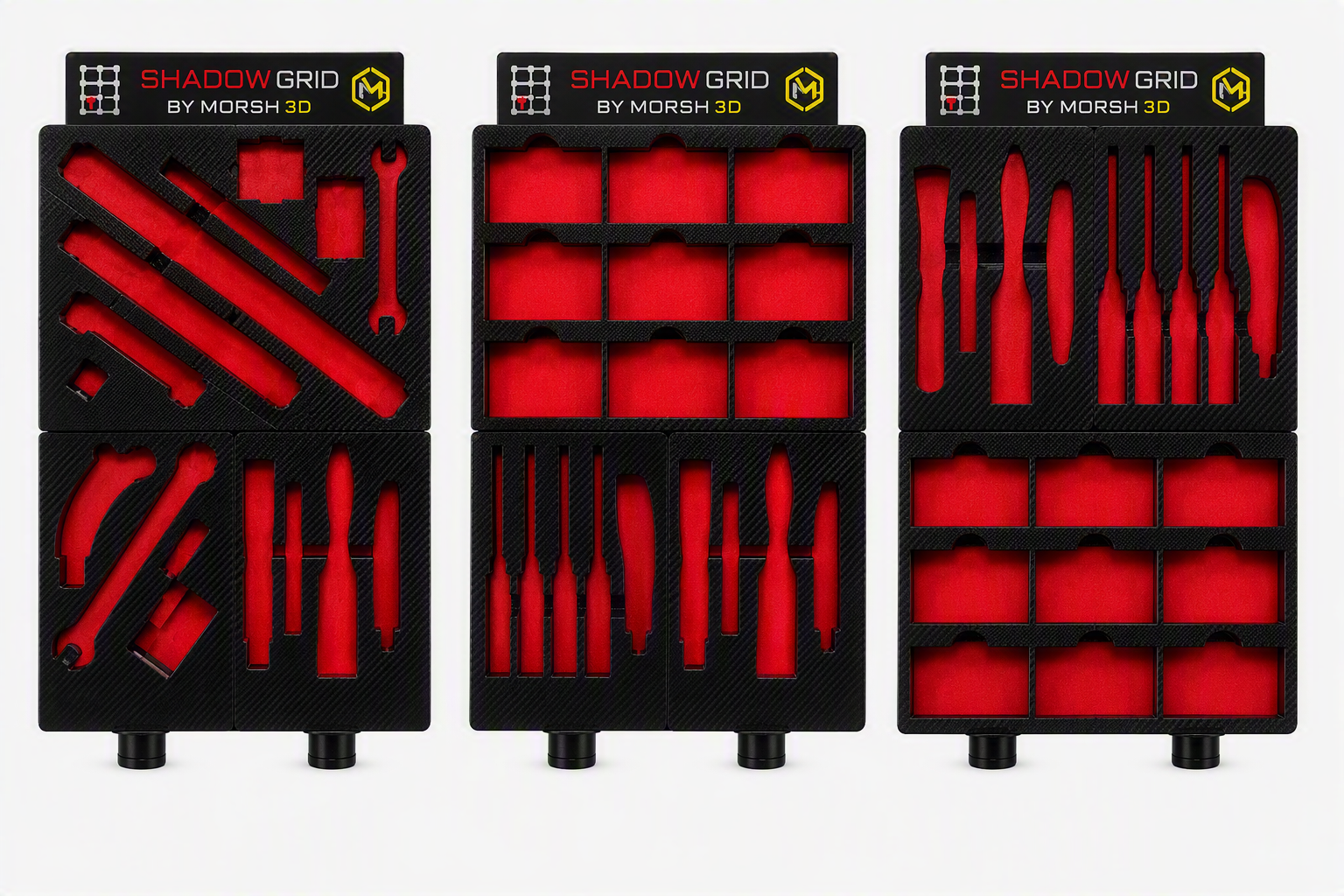
Instead of treating a shadow board as one permanent panel, Shadow Grid uses individual custom-made shadow tiles fitted into a modular supporting grid.
Each tile contains the storage profile for a specific tool or group of tools. The tiles can be moved, swapped, flipped or replaced individually as requirements change.
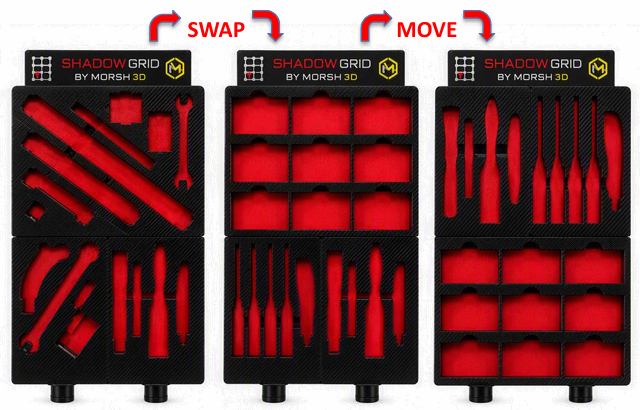
If a tool is replaced, you do not need to replace the complete board. You simply order a new tile for that part of the layout.
If the workstation changes, the existing tiles can be rearranged. Tiles can even be swapped between separate boards on different workstations if the manufacturing workflow changes.
If additional storage is required, grids can be connected to expand the system.
This creates a shadow-board solution that can evolve alongside the workplace it supports.
Key features of Shadow Grid
Modular and interchangeable
Individual shadow tiles can be removed, relocated or replaced without remanufacturing the complete board. This makes it far easier to maintain an accurate visual standard as tools and processes change.
Customised around your equipment
Each tile is designed around the customer’s own tools. Creating the layout begins with a straightforward photograph of the equipment arranged on A4 paper, together with the required tile depth and colour.
A choice of tile sizes and depths
Tiles are available in A4, A5 and A6 formats, allowing different tools to be grouped logically within the same board. Multiple depths from 5 mm to 25 mm accommodate equipment of different sizes and profiles.
Clear missing-tool identification
Contrasting colours make an empty tool position immediately visible. This supports quicker checks, better accountability and more effective 5S auditing.
Expandable
Multiple boards can be connected when additional capacity is needed. A workstation can therefore begin with a smaller installation and grow without abandoning the original system.
Wall-mounted or desktop use
Shadow Grid can be configured for wall-mounted storage or as a freestanding desktop board, making it suitable for production cells, assembly areas, maintenance workshops, inspection stations and other working environments.
Optional identification and digital features
Custom header text can identify the workstation, department, tool set or process. Optional bolt-on wireless NFC tags can also provide quick access to digital information such as work instructions, inspection records, tool registers or training material.
Supporting continuous improvement—not working against it
The purpose of continuous improvement is to make processes safer, simpler and more effective. The systems surrounding those processes should be capable of changing with them.
A conventional shadow board captures a workplace at one moment in time.
Shadow Grid is designed for what happens next.
By allowing individual sections to be rearranged or replaced, it helps businesses preserve the benefits of visual management without repeatedly replacing an entire board whenever the process evolves.
That means less waste, fewer improvised modifications and a storage system that can remain relevant throughout ongoing 5S and continuous-improvement activity.
Because the best visual-management solution is not simply the one that looks organised on installation day.
It is the one solution that stays organised when the workplace changes.
Shadow Grid is designed and manufactured by MORSH 3D. To discuss a custom configuration for your tools, workstation or production environment, contact us via enquiries@morsh3d.com or visit morsh3d.com.